Key Insight #1: Early Mentorship & Research Exposure
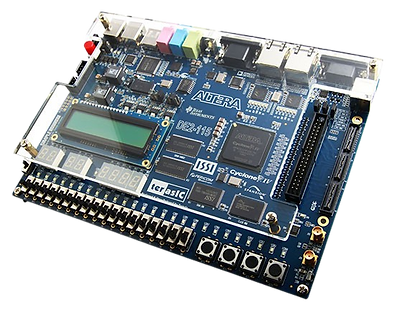
The DE2-115 FPGA development board that I used to implement and test the three-stage pipelined RISC-V processor designed in CSCE 611.
Through my academic curriculum, I completed several systems-focused and architecture-oriented courses, including CSCE 212 (Introduction to Computer Architecture), CSCE 313 (Embedded Systems), and CSCE 611 (Advanced Digital Design). These classes helped me build a strong technical foundation in low-level system behavior, constraint-aware design, and algorithmic reasoning. They emphasized precision, efficiency, and correctness; each offering a unique analytical skill set necessary to understand complex computing systems. For instance, my final project for CSCE 611 involved designing and implementing a three-stage pipelined processor in Verilog. Through this project, I learned core architectural concepts, including instruction pipelining, timing synchronization, and correctness verification under hardware constraints. Namely, I visualized the CPU signals using GTKWave and optimized the processor for deployment on the DE2-115, demonstrating how instructions progress through the pipeline and verifying the processor's functional correctness. For my within-the-classroom (WTC) artifact, I've included a screenshot of the GTKWave visualization below:

WTC Artifact. GTKWave visualization of internal CPU signals during execution of the assembly test program for the three-stage pipelined RISC-V processor. Click to enlarge
Despite my initial achievement, the knowledge I had acquired felt fragmented. While I could apply concepts within individual classes, I had not yet developed a clear sense of how these skills aligned with a broader academic or professional direction. I realized I would need a more structured opportunity to understand how they could apply beyond the classroom.
My transition into research began when Dr. Rasha Karakchi, my embedded systems professor, recognized my interest in systems-level computing and encouraged me to apply for the McNair Junior Scholars fellowship. Through this program, I was introduced to independent research for the first time, moving beyond structured coursework into open-ended exploration within my area of expertise. During this process, I collaborated closely with three research colleagues who shared the same research advisor. Together, we exchanged ideas, offered feedback, and supported each other’s progress, strengthening both my technical understanding and ability to work effectively in a research team.
At this point in time, my independent work was Machine Learning-Based Detection of Simulated Malware in FPGA Bitstreams, where I applied machine learning techniques to identify potential security threats in reconfigurable hardware. I implemented and tested these experiments on the PYNQ-Z1, allowing me to evaluate real-time performance and resource constraints in a physical hardware environment. Concepts from CSCE 611, particularly instruction pipelining and hardware design, directly informed my approach to this work. Rather than treating the FPGA as an abstract platform, I applied these principles to reason about timing behavior, resource utilization, and functional correctness, transforming architectural theory into concrete decision-making tools within a real research setting. This project marked a shift from completing predefined assignments to formulating research questions, evaluating feasibility, and navigating uncertainty. With Dr. Karakchi’s mentorship, I began applying my classroom knowledge to real-world technical problems and showcased my early findings at the 2025 Summer Research Symposium. For my beyond-the-classroom (BTC) artifact, I have included my symposium poster below:

The PYNQ-Z1 FPGA development board that I used to deploy an ML-based malware detection framework.

BTC Artifact. Research poster presented at the 2025 Summer Research Symposium as part of the McNair Junior Scholars Program. Click to enlarge
Ultimately, the McNair program reframed my view of coursework by providing a context in which theoretical knowledge had a clear purpose. Concepts from CSCE 212, CSCE 313, and CSCE 611 became tools for exploration rather than isolated requirements. The contrast between classroom clarity and research uncertainty revealed the importance of intentionality in applying technical knowledge. These many connections transformed my undergraduate experience from one of accumulation to one of purpose-driven learning. As a result, I approached both my educational and professional life more deliberately, with a clearer sense of purpose and direction.
Overall, I learned that early mentorship, combined with structured research exposure, is essential for transforming technical coursework into meaningful academic direction. This key insight changed my approach to academia. Rather than passively progressing through requirements, I began actively seeking opportunities to apply and extend my knowledge within research-driven contexts.
Additional Photos:

Photo 1. This photo was taken at the 2025 Summer Research Symposium and showcases me presenting my work.

Photo 2. This photo was taken at the 2025 Summer Research Symposium and features me with three research colleagues I met through the McNair Junior Scholars program.
Photo 1. This photo was taken at the 2025 Summer Research Symposium and showcases me presenting my work.